Having transitioned from the financial sector into the complex world of lubricants and heavy engineering nearly a decade ago, I’ve been consistently intrigued by the opportunity to view and dissect oil market trends through the lens of my financial acumen. This perspective aids not only myself and our company but also anyone who might find such insights valuable.
Of late, the global base oil market has been in a state of frenzied flux, with prices for basic oil grades nearly doubling in a remarkably short time. This has naturally piqued my interest, and the pricing quirks of Hydraulic Oil, the world’s most utilized lubricant, present a particularly compelling case.
The scenario is quite bewildering. While a drum of Hydraulic HM-68 typically retails between R23.50 and R27.00 per litre in a 208-210L drum, we’ve observed the same grade being offered at the much lower R17.50-R19.00 price range. Considering the current dollar exchange rate and the prices of base oils sourced directly from European traders, the R17.50 market offer seems to be selling at a rate 10-15% below the cost of the base oil mix—this is even before accounting for the costs of an additive package and a drum. The market is nonetheless assured that this hydraulic oil is derived from virgin base oils and meets all specifications. This discrepancy raises questions since the arithmetic just doesn’t add up.
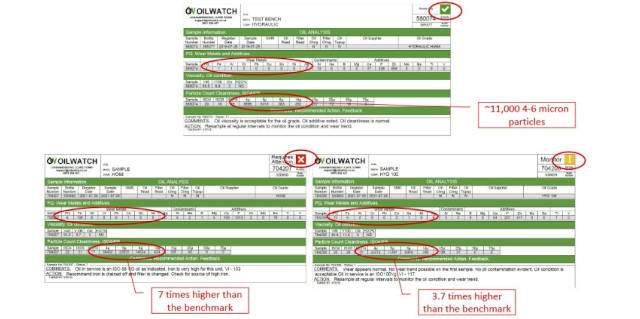
To demystify this, we procured two samples from different suppliers and sent them off for independent chemical testing. These samples, purchased as new hydraulic oil, produced the results shown on the slide. The top sample, a standard HM-68, is fully compliant with DIN 51524 part 2 (21/19/16) and serves as our benchmark. The other two samples, purchased for comparison, are displayed on the bottom left and right.
As the slide reveals, both samples are heavily contaminated with 4–6-micron particles, outstripping the benchmark levels by 3.7 times (on the right) and a staggering 7 times (on the left). The iron present in the first sample (on the left) is 136 times greater than in the benchmarked sample and was flagged by the lab as non-compliant. They recommended either replacing the oil or at least filtering it and changing the filter in the hydraulic system. In other words, continuing to use this oil could lead to system blockages and equipment failure.
The second sample (on the right) demonstrated extreme metal contamination, exceeding the benchmark by sevenfold. The lab classified this oil as a “watch out” grade—indicating it would require constant monitoring and likely early replacement to prevent equipment deterioration.
Such levels of particle/metal contamination strongly hint at the partial use of either refined base oil or used oil in the production process. The quality of refined oil and the mix ratio between virgin and refined/used oils will yield higher or lower levels of contamination.
To illustrate this point, let’s consider a rudimentary blending comparison. The current price for base oil mix (SN150 and SN500) for HM-68 will fetch you between R17.00 and R18.50 per litre, with additives contributing an extra R1.50 to R2.00. Once you account for packaging, labour, manufacturing, and re-sellers margins, you reach the aforementioned price range of R23.50 to R27.00. However, if you introduce refined oil—currently obtainable for between R6.00 and R10.00 per litre—at a 50/50 mix, your average base oil cost drops to approximately R12.87 [(R17.75+R8.00)/2], achieving the desired R5.00-R7.00 reduction in hydraulic.
Please click the link on the original Engineering News article.